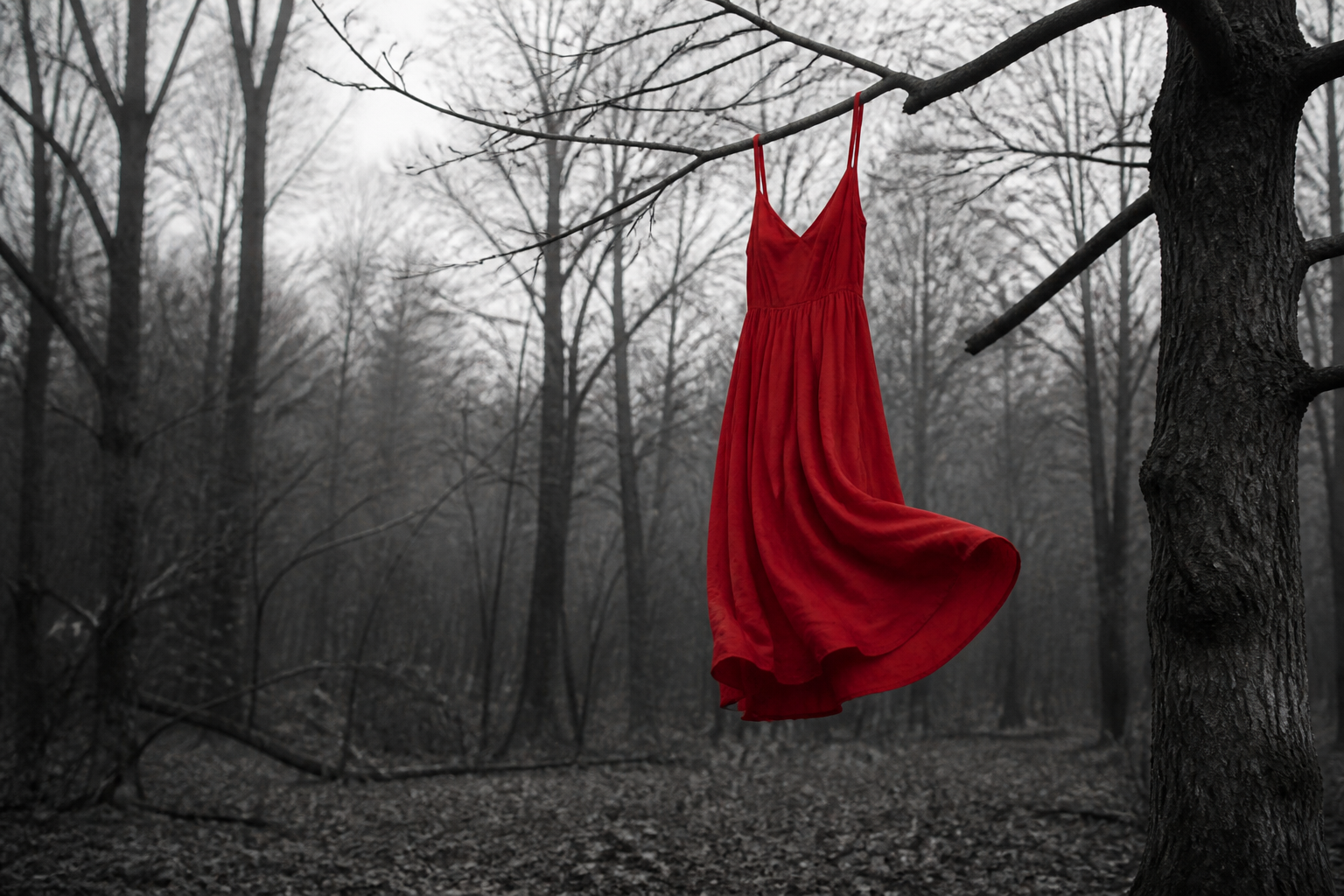
You have seen the red handprint across a mouth. You may have seen empty red dresses hung in trees, on campuses, along fences. Both belong to the same movement, and both were made by artists, not committees.
The REDress Project
In 2010, Métis artist Jaime Black began hanging empty red dresses in public space to mark missing and murdered Indigenous women. The dresses are empty on purpose. As Black put it, people notice "there is a presence in the absence." Red was chosen deliberately — in the teaching she drew on, red is the colour the spirits can see.
The handprint
The red handprint painted over the mouth grew out of the same movement. It stands for the voices that were silenced, and for the cases that were never seriously investigated. It is worn, not displayed — which is why it appears on people rather than on walls.
May 5
In the United States, May 5 is the National Day of Awareness for Missing and Murdered Indigenous Women and Girls. The date is the birthday of Hanna Harris, a young Northern Cheyenne woman murdered in 2013 whose case became a rallying point for families demanding that these disappearances be treated as crimes rather than statistics.
The scale
The figure most often cited is that roughly one in three Indigenous women is sexually assaulted in her lifetime, with a majority of those assaults committed by non-Native perpetrators — a jurisdictional gap that has made prosecution difficult for decades. That gap, not the violence alone, is what the movement is arguing about. We want to be straight with you about this number: we could not pull it directly from a US federal database, so treat it as widely reported rather than as something we verified at the source. If you need the primary data, start with the Department of Justice and the National Institute of Justice.
If you wear this one, know what it says before someone asks you.