He Could Not Read a Word in Any Language
Cherokee Nation / Eighty-six characters / 1821
He could not read a word in any language.
In the whole of human history, writing has been invented from nothing only a handful of times. One of those times, the man who did it was a silversmith who could not read a word when he began, not in English and not in anything else.

About 1809
Twelve years on a thing nobody around him believed in
Sequoyah was a Cherokee silversmith. He had no schooling and no key to work from. He could not read English, and there was nothing written in Cherokee for him to read, because nothing in Cherokee had ever been written.
What he had was one observation. Marks on paper carried a man’s speech to another man who was not there to hear it. He decided that was a thing a person could build, and around 1809 he started trying to build it.
There is no way to make that kind of work look like work. Somebody walks past and sees a silversmith who is not making anything. Marks scratched onto bark and board, going nowhere, meaning nothing to anyone but the man scratching them.
Everything he needed was already inside his own head. He had to get it out one piece at a time, listening to his own language until he could hear exactly where each sound stopped and the next one started, and then find a mark for it that could not be confused with any of the others.
He worked at it for twelve years. Twelve years is a long stretch to spend on something the people around you are certain does not exist and cannot be made.
1821 · Cherokee Nation
The man they tried for witchcraft, then asked to teach them
In 1821 he finished. Eighty-six characters, one for each syllable in the language. Not an alphabet borrowed from somewhere else and bent until it nearly fit. A system built for the sounds people were actually saying.
He and his young daughter were accused of witchcraft and brought before a council. The council separated the two of them, and made each one write a sentence for the other to read aloud.
It is worth sitting with what that council did. They could have settled a question that size by voice alone and nobody would have argued with them. Instead they built the one procedure that cannot be faked, ran it, and then changed their minds about him in front of everybody. That is not a small thing to do in public.

- 12
- Years of work, unable to read
- 86
- Characters, one per syllable
- 1821
- The year of the blind test
A man who could not read handed an entire nation the ability to write. He carried it in himself, into a room where nobody wanted it.
What the writing did next · 1825 to 1838
- About 1825 Within roughly five years, most of the nation could read and write. It spread person to person. People simply taught each other.
- 1827 The Cherokee write a constitution of their own, in their own hand.
- 1828 The Cherokee Phoenix begins printing, in two languages. A people described as having no written word are publishing a newspaper.
- 1832 Worcester v. Georgia is decided at the Supreme Court of the United States, in the Cherokee Nation’s favor.
- 1835 The newspaper’s printing press is seized.
- 1838 About sixteen thousand people are removed from their homes. About four thousand do not arrive. One in four.
The press could be carried off. The writing could not, because it was never in the press. It was in the heads of sixteen thousand people, and it walked the entire distance with them.
That is the whole reason any of this reaches us. Not the paper, which was taken, and not the building it was printed in. People, holding a thing in mind and handing it to the next person while they were still able to.
Which is also the weak point. A thing that lives in people can go out of the world with them, quietly, in a single generation, and nobody writes down the day it stopped.
A written language, a constitution of their own, a newspaper in two languages, a case won at the highest court in the country. The press was carried off anyway. Nothing written down has ever kept itself alive.
Those eighty-six characters are still written today. And they still move the way they moved in 1821. One person at a time, carried by somebody who knows what they are.

So that is what we make. Not a picture of the record and not a slogan about it. The record itself, at a size a stranger can read from a few feet behind you, on the back of the person carrying it.
It works the way a historical marker works, except this one walks into rooms. Someone reads it. They ask what it is. And the history gets one more crossing it would not otherwise have had.
- 01At the register, when the person behind you reads it while you are paying.
- 02On the sidewalk outside a school gate, where a dozen people read your back while they wait.
- 03In a waiting room, where nobody is scrolling past you.
No feed reaches those three places. You do.
The ones people keep choosing
Every design carries a name, a place or a number.
Five of them, photographed by the people who wear them:
-
SequoyahThe Cherokee Syllabary · all 86 characters, back print · double-sided · $34.95
-
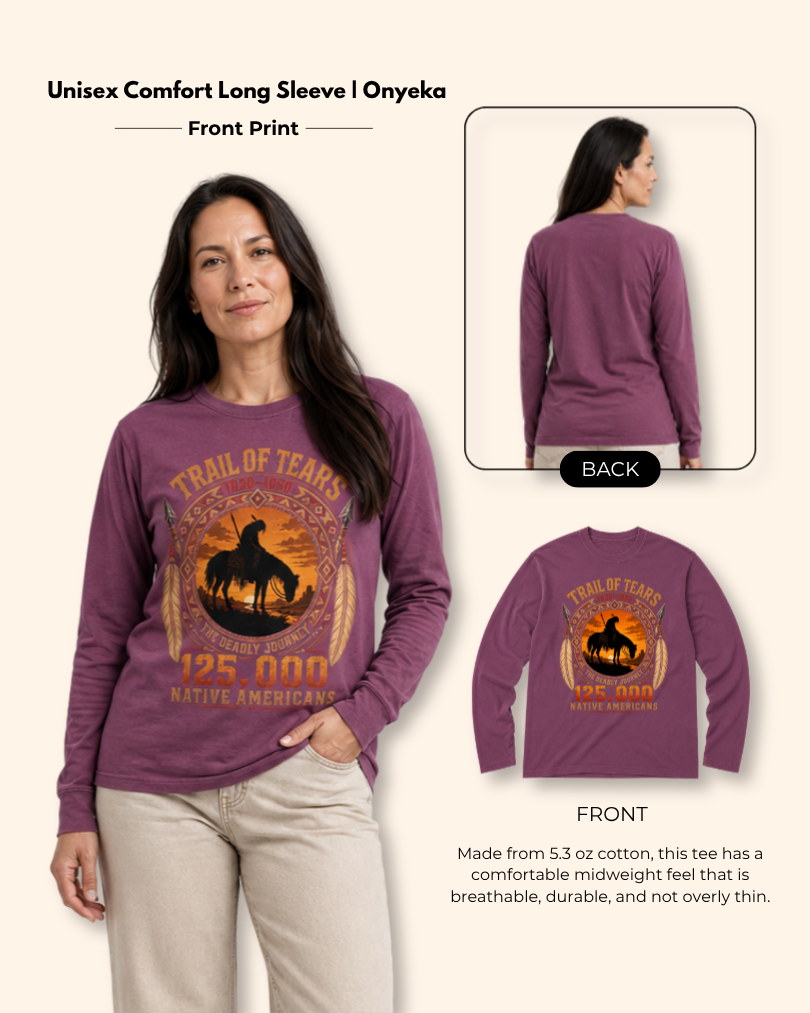
 Sakima IITrail of Tears · five colorways
-
 VarekStolen Native Children · long sleeve
-
 RokanDefend the Land
-
 ElariHonor the Man
Plainly, before you decide
- Wearable records
- 55 designs
- Price range
- $27.99 – $44.99
- Blank
- Comfort Colors, garment-dyed
- Sizing
- Unisex S – 4XL
- Production
- Printed to order
We print each one after it is ordered, so no countdown is going to appear on this page and nothing here is built to feel scarce. The only thing with a real clock on it is how long this history keeps getting skipped.
And when someone asks what it means
You do not need a lecture ready. One sentence carries it, and every part of it can be checked:
Say this
“A Cherokee silversmith who could not read invented a written language in 1821. Eighty-six characters, one for each syllable. Within about five years most of his nation could read and write.”
Carry the record, hand over the sentence, let them go look it up themselves.
Plainly: we are a small print operation. We are not a school, a tribal government, a nonprofit or a charity, and we do not speak for any nation. We make no claim that a portion of your purchase goes anywhere other than into running this.
What we do claim is that the history on these designs is real and checkable. Every year, number and name on this page can be looked up in the sources below, and we would rather you did.
Sources: Sequoyah and the Cherokee syllabary, completed 1821 · the Cherokee constitution of 1827 · the Cherokee Phoenix, first printed 1828 · Worcester v. Georgia, 1832 · the removal of 1838. Portrait of Sequoyah: lithograph, McKenney & Hall, published by F.W. Greenough, Philadelphia, about 1838, Library of Congress, Prints & Photographs Division; no known restrictions on publication.