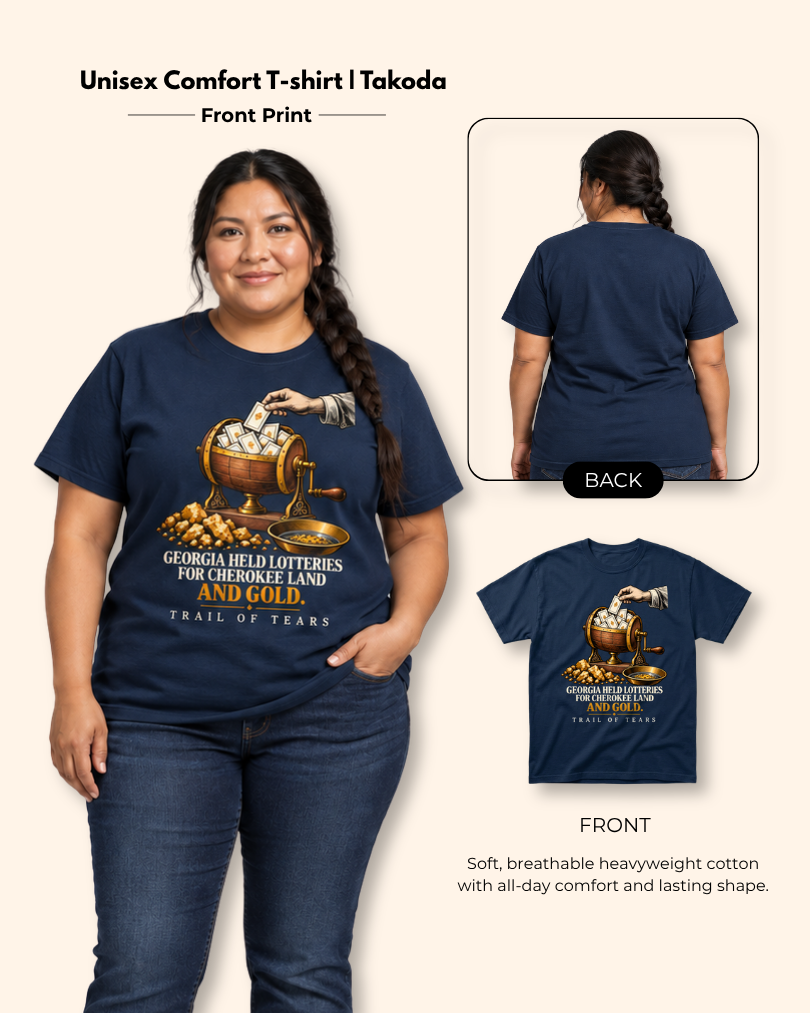
Here is a test you can run on any “historical” product listing, including ours, in about thirty seconds.
Find one thing on it you could look up. A date. A place. A nation by name. A number. Anything a stranger could type into a phone and land on a record.
Most of the time there is nothing. A feather, a silhouette, a mountain range, and a line of sentiment that could be about anywhere and anyone. It is designed to be felt, not checked — and something built to be felt but not checked collapses the moment somebody in a queue says “oh — what's that about?”
That question is the only moment that matters. Everything below is about products that cannot answer it, and the three ways they fail.
What passing the test looks like


Vendor: Americanista
Kaira — Trail of Tears — Heritage Tee


Vendor: Americanista
Imala — Trail of Honor — Heritage Tee


Vendor: Americanista
Kiona — Trail of Tears — Heritage Tee


Vendor: Americanista
Talona — Stolen Native Children — Heritage Tee

THE QUOTE THAT WAS NEVER SAID
The most printed “Native American” words in retail were not said by a Native American. Chief Seattle's famous speech about the earth being our mother was written by a screenwriter named Ted Perry, for a 1972 environmental film. The producer left his name off because it sounded “more authentic” as Seattle's.
The giveaway is in the text. It has him grieving buffalo shot from passing trains. Seattle lived on Puget Sound. There were no bison within six hundred miles of him, and no railroad west yet. He never saw one.
It is on posters, mugs and shirts to this day. So is the John G. Burnett letter about the Trail of Tears, which is also a forgery — his company was disbanded a year before the removal it describes.
A product built on a quote nobody checked is not honouring anything. It is passing on a rumour with a price tag.

NOTHING ON IT SURVIVES A SEARCH
Run the thirty-second test down a rack of them. Dreamcatchers, wolves, feathers, silhouettes on a ridge, a slogan about spirit or strength. Beautiful, often. Completely unsearchable.
There is a reason for that, and it is not artistic. A date can be wrong. A number can be checked. A nation named is a nation you can be corrected about. Vagueness is not a style choice — it is what you print when you do not want to be accountable for anything specific.
And it fails at the only job the garment has. Nobody stops a stranger to ask about a feeling. They stop them about a number they have never seen before.

THE THIRD ONE IS OURS
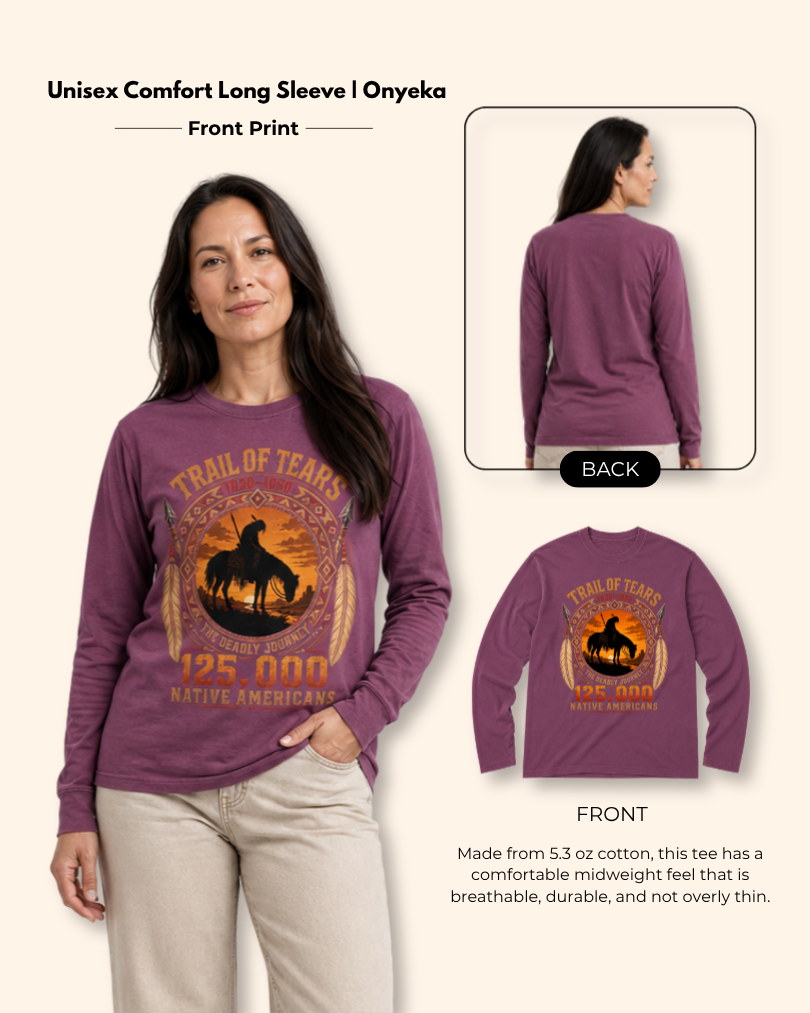
We printed a shirt that read 125,000 NATIVE AMERICANS. It was on the site for months. It was on our own landing page as recently as yesterday morning.
We cannot source that figure. Nobody can. The National Park Service records about 16,000 Cherokee removed in 1838 and about 4,000 who did not finish the walk; across all five nations roughly 100,000 people were moved, and the rolls that would say how many arrived were never reconciled. Where 125,000 came from, we do not know — which is exactly the problem.
It came off on 16 August 2026, along with an urgency element that had no real deadline behind it.
We are not writing that to look humble. We are writing it because a page attacking unsourced claims, from a shop that made one, is worth nothing unless it names its own.
THE RULE WE PRINT BY NOW
Every design has to carry at least one thing a stranger can check. A date. A route. A nation by name. A count with a source behind it.
No figure goes on a garment unless we can say where it came from. If the honest answer is that nobody agreed on a number, the shirt says that instead — that disagreement is the story.
No quote unless it is attributable. Not attributed. Attributable — traceable to something written down at the time by somebody who was there.
Printed big enough to read across a room. A fact nobody can see from two metres away is decoration.
That is a narrower brief than most of this category works to, and it rules out most of what sells well in it. It is also the only version where the person wearing it can answer the question.
Trail of Tears Commemorative Collection
Every design here prints something specific — a date, a route, a nation, a count — big enough that a stranger reads it across a room without choosing to, and can go and check it before they get home.
You are not buying a shirt. You are volunteering to be asked.

Customers, at home, on an ordinary day
THE RIPPLE EFFECT OF TRUTH
A shirt is not a monument. It is smaller, and it moves — to the grocery store, the waiting room, the school pickup line, where a monument is never going to reach. Somebody reads it over your shoulder and asks what it means. That question is the whole mechanism.
Tap a clip for sound. Tap the name to see that design.
WHAT PEOPLE WHO ACTUALLY WEAR THESE SAY
Copied word for word out of the store’s review app — names, products and all. Including the one about the sizing.
JC
Exceeded my expectations. The cotton fabric is super comfortable, the fit is spot on, and customer support was incredibly helpful. 10/10 for both product quality and service

Erma F.
Tshirt is exactly as described. Well made, proudly created. Glad I purchased it!
David R.
Your products are excellent. I love the quality of design, materials and service.

Shari
I absolutely love this tshirt! It is so pretty and very well made. It is so comfortable and soft!

Marrilyn E.
I just don't do photographs, but the shirts fit both my husband and myself just fine. Great shirts, we love them.
Kathryn M.
Very well made. Good material and the logo is heartbreaking in its story.

Colleen M.
I havent yet had the opportunity to wear it because I seldom leave the house. But I promise I will when the occasion permits! I still love the shirt, even if I haven't worn it yet.
IF IT ISN'T RIGHT, YOU ARE NOT STUCK WITH IT
Buying a shirt online from a shop you have not bought from before is a small act of trust. Here is exactly what happens if it goes wrong — no countdown, no invented statistics, nothing we cannot stand behind.