Before They Took the Land, They Took the Printing Press.
For anyone who wants to know how a record actually gets destroyed
Before they took the land, they took the printing press.

The Cherokee had a national newspaper. It was called the Cherokee Phoenix and it started in 1828.
It printed in English and in Cherokee, side by side, in a written alphabet a silversmith had invented for them in the 1820s.
Understand what that means. Inside one generation they went from no writing system at all to a bilingual press.
You were not taught that, and there is a reason the second half of this is not taught either.
In 1835 the state came for the press
Word got out that the press was to be moved out of New Echota, north to Red Clay in Tennessee, out of Georgia’s reach.
The Georgia Guard got there first.
They destroyed the press and they burned the printing office.
Three years later the removal began.

What they could not burn
The alphabet survived, because an alphabet does not live in a building.
Back copies survived, because copies had gone out to subscribers and libraries.
The Library of Congress catalogues the Cherokee Phoenix today. You can look up the record number.
The paper was eventually restarted, and it still publishes.
The eighty-six characters are still written by people who are alive right now.

Here is the part that is about you
You do not need a bloodline to care that somebody tried to burn a record.
That is not an identity question. That is a question about whether things get to stay true.
A record survives for one reason only. Enough people keep a copy where somebody else can see it.
Right now the number of people carrying this one around is very small.
You can close this tab and it goes back to nobody.
Why say any of it on a shirt?
Because a shirt is a copy, and a copy is the only thing that has ever beaten a fire.
A library reaches whoever walks into the library.
What actually moves is a stranger reading something off your back and asking what it means.
Ninety seconds later they know it too. That is the whole mechanism.
What people wear it for
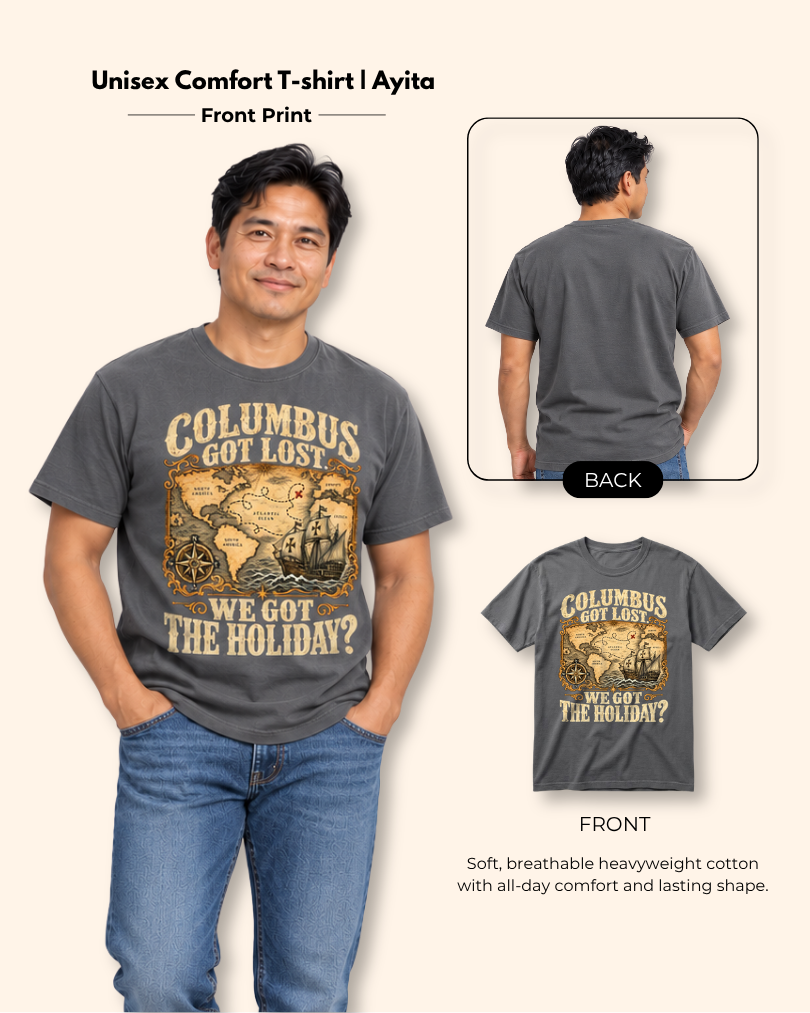
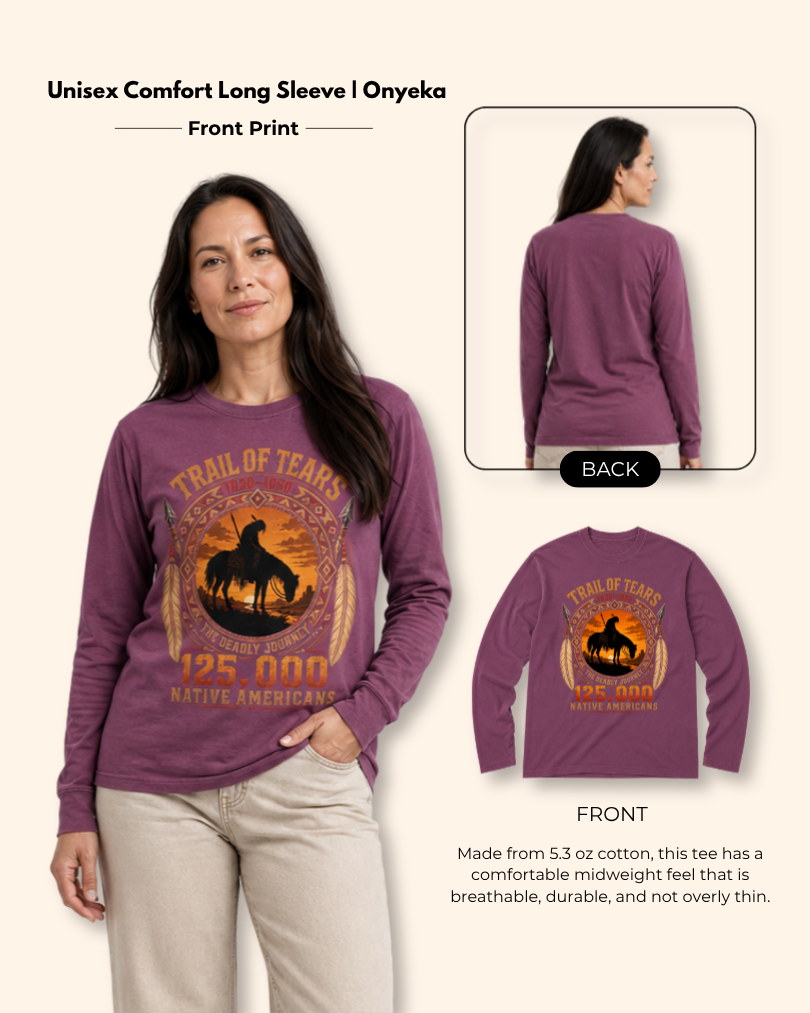
Some carry the alphabet itself. Some carry the road. Some carry the answer to the question they keep getting asked.
The same argument, worn differently.


Comfort Colors, printed after you order. Made in 1–3 business days, then 4–8 business days in the US. Free shipping over $95.
To wear it on Monday, October 12, order by September 25.
The bottom line
A state destroyed a nation’s printing press, and three years later marched that nation west.
The alphabet outlived the people who burned the building.
And now you know. What happens to that is up to you.
Comfort Colors, printed after you order. Made in 1–3 business days, then 4–8 business days in the US. Free shipping over $95.
To wear it on Monday, October 12, order by September 25.
Americanista is not a Native-owned business, and these are not Indian products under the Indian Arts and Crafts Act of 1990. The design names are ours, not tribal names. We are the people who print the record, not the people it happened to.
We are a small print operation. Not a school, not a tribal government, not a charity. We make no claim that any part of your purchase goes anywhere other than into running this.
Sources: The paper and its destruction: New Georgia Encyclopedia, “Cherokee Phoenix”; Cherokee Phoenix, “History of the Cherokee Phoenix” (cherokeephoenix.org); University of Michigan, “The Cherokee Phoenix,” Resistance in Early American History. The press was destroyed and the printing office burned by the Georgia Guard in 1835, after word leaked that the press was to be moved from New Echota, Georgia to Red Clay, Tennessee. Catalogue record: Library of Congress, Chronicling America, Cherokee Phoenix, sn83020874. The Cherokee syllabary, eighty-six characters, was completed by Sequoyah in the 1820s and remains in use. Removal totals: approximately 16,000 Cherokee forced west and approximately 4,000 deaths, the figures carried by the National Park Service. Shipping and production times from americanista.com/policies/shipping-policy.