She Was Nearly Eighty and Too Weak to Stand. She Sent Her Son to Read It Out Loud.
You have been in the room where somebody was waved off. So were they
She was nearly eighty and too weak to stand. She sent her son to read it out loud.

Her name was Nanyehi. The records also carry her as Nancy Ward.
In May of 1817 the Cherokee council met at Amohee to talk about selling land.
She was old and she was ill and she could not get there to speak.
So she wrote it down instead, and sent her son to read it into the room for her.
You have almost certainly never seen the sentence she put in it.
Thirteen women signed it
Her own daughter signed. Her granddaughter signed.
The argument was not sentimental. It was practical, and it was about land.
Sell pieces of it, they said, and there will be nothing left to stand on.
They petitioned again the following year, in 1818, when nobody had listened the first time.

She did not live to see whether she was right
Nanyehi died around 1822.
Sixteen years after that, in 1838, the removal came and took the rest of it.
Sixteen thousand Cherokee were forced west. About four thousand of them did not survive the journey.
Everything the thirteen women had written down happened, in order, exactly as described.

Here is the part that is about you
You have been in a version of that room. Most people have.
Somebody said the thing early, said it plainly, and got waved off.
The difference is that this one was written down and kept, so we can check.
It is sitting in a government archive right now and almost nobody reads it.
You can close this tab and it goes back to nobody.
Why say any of it on a shirt?
Because a page like this only reaches somebody who already went looking.
An archive reaches whoever knows the catalogue number.
What actually moves is a stranger reading something off your back and asking what it means.
Ninety seconds later they know it too. That is the whole mechanism.
What people wear it for
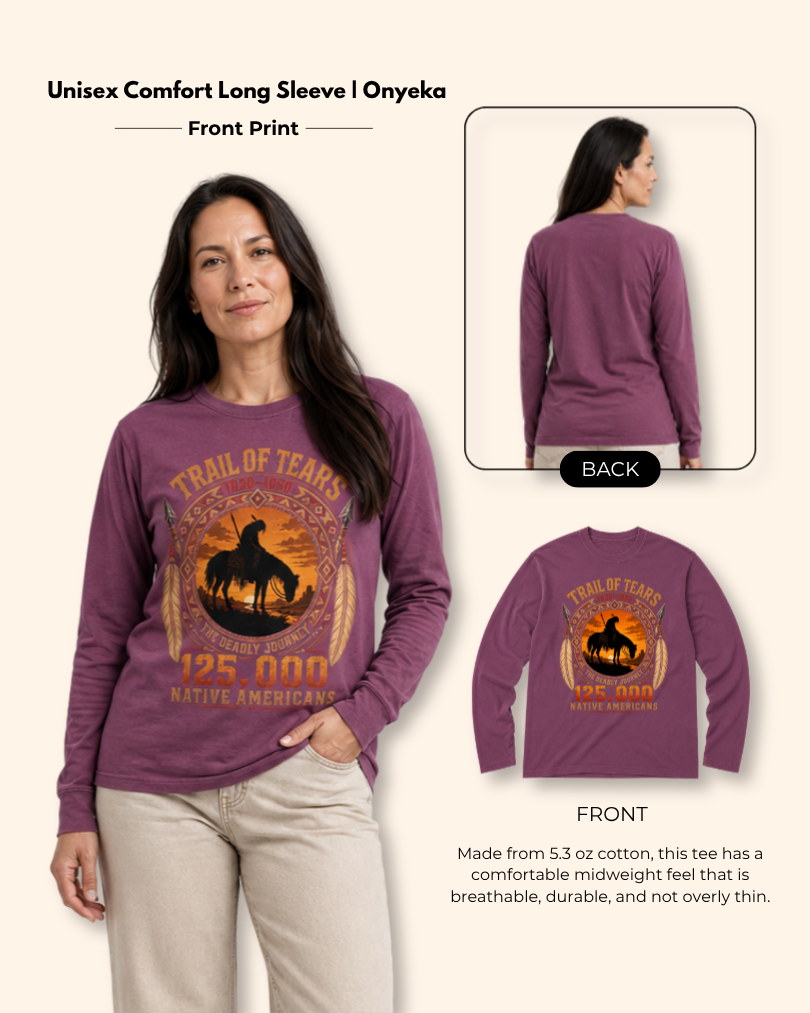
Some carry the road. Some carry a name. Some carry the answer to the question they keep getting asked.
The same argument, worn differently.


Comfort Colors, printed after you order. Made in 1–3 business days, then 4–8 business days in the US. Free shipping over $95.
To wear it on Monday, October 12, order by September 25.
The bottom line
Thirteen women wrote down exactly what was coming, twice, and signed their names to it.
It was ignored, and then it happened.
And now you know. What happens to that is up to you.
Comfort Colors, printed after you order. Made in 1–3 business days, then 4–8 business days in the US. Free shipping over $95.
To wear it on Monday, October 12, order by September 25.
Americanista is not a Native-owned business, and these are not Indian products under the Indian Arts and Crafts Act of 1990. The design names are ours, not tribal names. We are the people who print the record, not the people it happened to.
We are a small print operation. Not a school, not a tribal government, not a charity. We make no claim that any part of your purchase goes anywhere other than into running this.
Sources: The petitions: Cherokee women’s petitions of May 2, 1817 and 1818, held in the Library of Congress, Andrew Jackson papers (“Cherokee Indian/Native American Women to National Council at Amohee, May 2, 1817”); transcriptions published by the Bill of Rights Institute (“Cherokee Women Address Their Nation, 1817”) and Teaching American History (“Petitions of Cherokee Women”). Nanyehi, also recorded as Nancy Ward, Beloved Woman of the Cherokee: Gilder Lehrman Institute; New-York Historical Society, Women & the American Story. Removal totals: approximately 16,000 Cherokee forced west and approximately 4,000 deaths, the figures carried by the National Park Service. Shipping and production times from americanista.com/policies/shipping-policy.