He Died Beside a Road You Have Probably Driven
For anyone who has wondered what they were not told
He died beside a road you have probably driven.

His name was Ezekiel Roebuck.
You have never heard it. Almost nobody has.
He was Choctaw. In the winter of 1831 he was being marched west with his wife and children.
A chief on that same march told a newspaper in Little Rock what it was: a trail of tears and death.
That is where the name you know comes from. It was his people it was said about first.
Somewhere in Arkansas, near the Ouachita River, he came down with cholera.
He said nothing about it for as long as he could, because he knew what they would do.
Then he collapsed, and the driver said it out loud
“I will have to put him out. We can’t afford to have anyone with the cholera along.”
That is not a paraphrase. That sentence was remembered and written down.
They stopped the wagon. They put him at the side of the road.

His wife’s answer is the part that stays with you
He called her Little Blue Hen. She listened to the driver, and then she said:
“Then put the children and me out too.”
His last words were to her.
“My soul will rest much easier if I knew you were safe.”
Then the road took him, and the road kept going, and nobody marked the spot.
So how do we know any of this?
Because of one afternoon in 1937.
On the thirteenth of October that year, a woman named Josephine Usray Lattimer sat down with a government interviewer.
She was his great-granddaughter. She repeated what had been passed down to her, word for word.
A clerk typed it up and filed it.
That page then sat in a box for the better part of a century.

Here is the part that is actually about you
The Choctaw went first, and Ezekiel Roebuck was one of them.
The Cherokee followed seven years later: sixteen thousand forced west, about four thousand of them did not survive it.
Almost none of those people got a grave anyone can point to.
Their names are not on anything. There is no wall. There is no list you can visit.
What there is, is a handful of pages like Josephine’s, and people who read them.
Right now that is a very small number of people.
You did not do this. Nobody is asking you to feel guilty about 1831.
But you are one of the few people who now knows his name, and that is a strange position to be in.
You can close this tab and it goes back to nobody.
The roads are still there
Nine states. Missouri, Kentucky, Arkansas, Illinois, Tennessee, Alabama, North Carolina, Georgia, Oklahoma.
They were not marched through a wilderness. They were marched through towns, past farms, past people eating dinner.
On roads that already had names.
Your commute might be on one of them. Your kid’s school bus might cross it twice a day.
We drive it at forty-five miles an hour with the radio on.

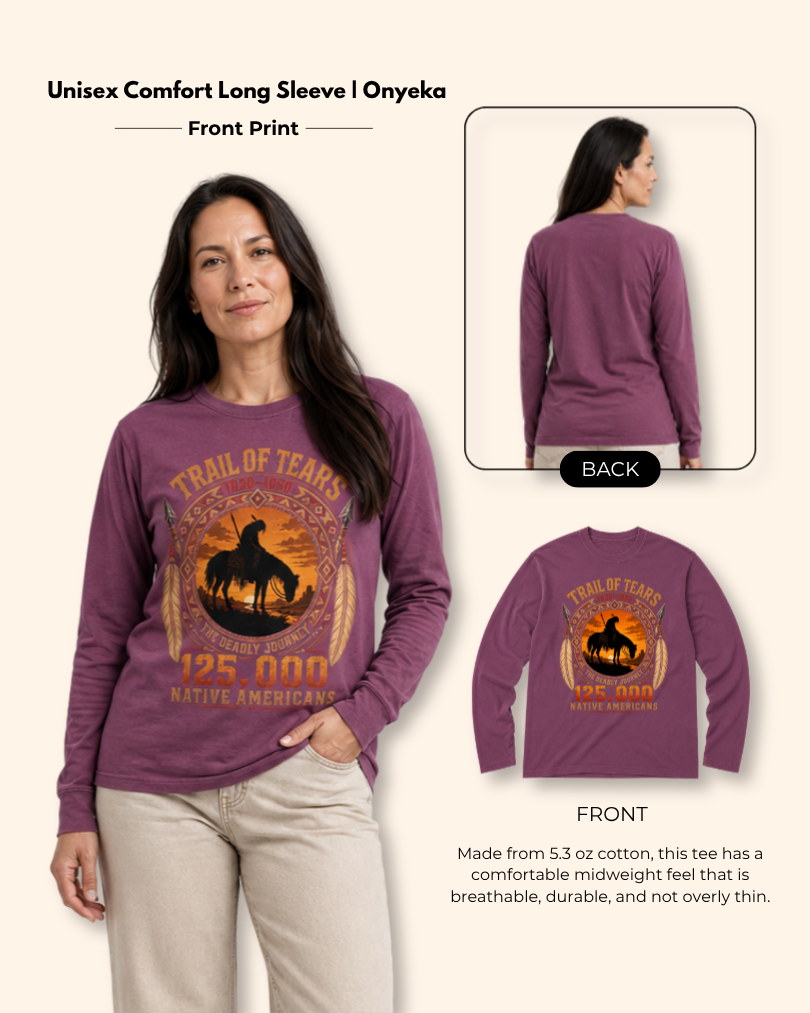
Why say any of it on a shirt?
Because a page like this reaches people who already went looking.
A grave reaches whoever drives to it, and there is no grave here.
What moves is a stranger in a queue reading something off your back and asking what it means.
Ninety seconds later they know his name too. That is the whole thing.

What people wear it for
Some carry the road itself. Some carry a name. Some carry the five nations who walked it.
They are all the same argument, worn differently.


Comfort Colors, printed after you order. Made in 1–3 business days, then 4–8 business days in the US. Free shipping over $95.
To wear it on Monday, October 12, order by September 25.
The bottom line
A man died beside a road in Arkansas and nobody marked it.
His wife got down off the wagon and stayed.
We know because his great-granddaughter told somebody in 1937.
And now you know. What happens to that is up to you.
Comfort Colors, printed after you order. Made in 1–3 business days, then 4–8 business days in the US. Free shipping over $95.
To wear it on Monday, October 12, order by September 25.
Americanista is not a Native-owned business, and these are not Indian products under the Indian Arts and Crafts Act of 1990. The design names are ours, not tribal names. We are the people who print the record, not the people it happened to.
We are a small print operation. Not a school, not a tribal government, not a charity. We make no claim that any part of your purchase goes anywhere other than into running this.
Sources: Ezekiel Roebuck, his last words, the driver’s words and his wife’s reply: Indian-Pioneer History Collection (Grant Foreman, ed.), interview with Josephine Usray Lattimer, October 13, 1937, recorded by Amelia Harris; reproduced in the University of Arkansas at Little Rock “Tribal Writers” exhibit, Family Stories of the Trail of Tears. Origin of the phrase: a Choctaw chief, on the 1831 removal, described it to the Arkansas Gazette at Little Rock as “a trail of tears and death”; the press carried the phrase and it was applied to the removals that followed. Removal totals: approximately 16,000 Cherokee forced west and approximately 4,000 deaths, the figures carried by the National Park Service. Nine states crossed by the Trail of Tears National Historic Trail: Missouri, Kentucky, Arkansas, Illinois, Tennessee, Alabama, North Carolina, Georgia, Oklahoma. Shipping and production times from americanista.com/policies/shipping-policy.