He Did Not Have to Go. He Went, and He Wrote Something Down Almost Every Day.
If you have wondered whether this is yours to carry, read this one
He did not have to go. He went anyway, and he wrote something down almost every day.

His name was Daniel Butrick. He was a missionary, and he was not Cherokee.
When the roundup started in May of 1838, nothing required him to go west.
He went. He walked the whole removal, and he kept a journal the entire way.
Weather. Distances. Who died that day, and where they were put in the ground.
You are reading about it because he did that.
The journal runs eleven months
It opens on the nineteenth of May, 1838, and closes on the first of April, 1839.
It is not a great work of literature. It is a man writing down what happened while it was happening.
That is exactly why it is worth anything.
Memory bends. A dated entry made the same evening does not.

What it cost him to be there
He was not in charge of anything and he could not stop anything.
He buried people. He recorded the burials.
He kept going through a winter that killed a great many of the people he was walking with.
Sixteen thousand Cherokee were forced west. About four thousand did not survive it.
A large part of what we can say for certain about those months, we can say because of his handwriting.

Here is the part that is about you
You are probably not Cherokee. Neither was he.
Nobody is asking you to claim a lineage or to feel guilty about 1838.
The man in this story did not claim anything either. He refused to let it go unrecorded, and that turned out to matter more than anyone expected.
That job is still open. It is open to anybody willing to carry the record where other people can see it.
You can close this tab and it goes back to nobody.
Why say any of it on a shirt?
Because a journal in a library reaches whoever finds the library.
He wrote it so somebody outside the room would know. That is the same job.
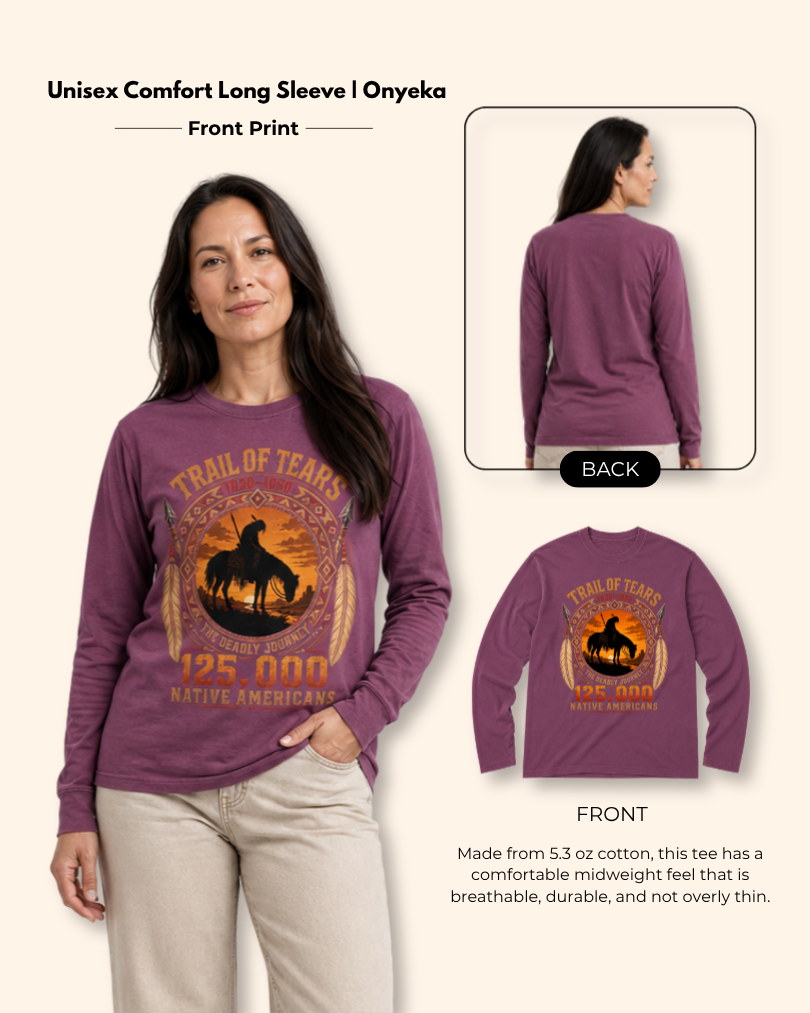
What actually moves is a stranger reading something off your back and asking what it means.
Ninety seconds later they know it too. That is the whole mechanism.
What people wear it for
Some carry the road. Some carry the alphabet. Some carry the answer to the question they keep getting asked.
The same argument, worn differently.


Comfort Colors, printed after you order. Made in 1–3 business days, then 4–8 business days in the US. Free shipping over $95.
To wear it on Monday, October 12, order by September 25.
The bottom line
A man with no obligation walked eleven months and wrote down what he saw.
That is most of the reason we can be specific about any of it.
And now you know. What happens to that is up to you.
Comfort Colors, printed after you order. Made in 1–3 business days, then 4–8 business days in the US. Free shipping over $95.
To wear it on Monday, October 12, order by September 25.
Americanista is not a Native-owned business, and these are not Indian products under the Indian Arts and Crafts Act of 1990. The design names are ours, not tribal names. We are the people who print the record, not the people it happened to.
We are a small print operation. Not a school, not a tribal government, not a charity. We make no claim that any part of your purchase goes anywhere other than into running this.
Sources: The journal: “Cherokee Removal: The Journal of Rev. Daniel S. Butrick, May 19, 1838 – April 1, 1839,” published by the Oklahoma chapter of the Trail of Tears Association; catalogued by WorldCat (OCLC 41645086) and held by the University of Wisconsin–Madison Libraries, among others. Butrick served as a missionary to the Cherokee with the American Board of Commissioners for Foreign Missions; the journal appears on the National Trail of Tears Association reading list. Removal totals: approximately 16,000 Cherokee forced west and approximately 4,000 deaths, the figures carried by the National Park Service. Shipping and production times from americanista.com/policies/shipping-policy.