They Had Just Buried a Quarter of Their Nation. Then They Took Up a Collection.
You were taught that people with nothing have nothing to give
They had just buried a quarter of their nation. Then they took up a collection for Ireland.

On the twenty-third of March, 1847, in Indian Territory, a group of Choctaw put money into a pot.
They counted one hundred and seventy dollars and sent it to Ireland.
You need to know what those same people had been through sixteen years before that.
In the winter of 1831 they had been marched out of Mississippi. Thousands never arrived.
They were still living on land the government had handed them, which was not good land.
Nobody asked them for it
The potato crop in Ireland had failed twice running. People were dying at the side of the road.
News of it reached Indian Territory the way news travelled then. Slowly, secondhand, in a newspaper somebody passed along.
The Choctaw had no connection to Ireland. No treaty. No trade. No shared border. Nothing.
They recognised something, and they acted on it.
That is the entire explanation anybody has ever been able to give.

Ireland never forgot it
In County Cork there is a memorial to it. Steel feathers standing in a circle, taller than a house.
Irish schoolchildren are taught this. Irish presidents have stood in front of it and said so out loud.
In 2020, when the virus tore through the Navajo and Hopi nations, Irish donors sent money the other way.
They wrote in the donation comments why they were doing it. They named 1847.

Here is the part that is about you
This is not a sad story. This is the best thing anybody did in the whole century.
And it is not on a wall anywhere in America. It is not in the textbook you were handed.
A country on the other side of the ocean remembers it better than the country it happened in.
You know it now. That is a strange thing to be holding on a Tuesday afternoon.
You can close this tab and it goes back to almost nobody.
Why say any of it on a shirt?
Because a page like this only reaches somebody who already went looking.
A memorial reaches whoever drives to it, and this one is four thousand miles away.
What actually moves is a stranger reading something off your back and asking what it means.
Ninety seconds later they know it too. That is the whole mechanism.
What people wear it for
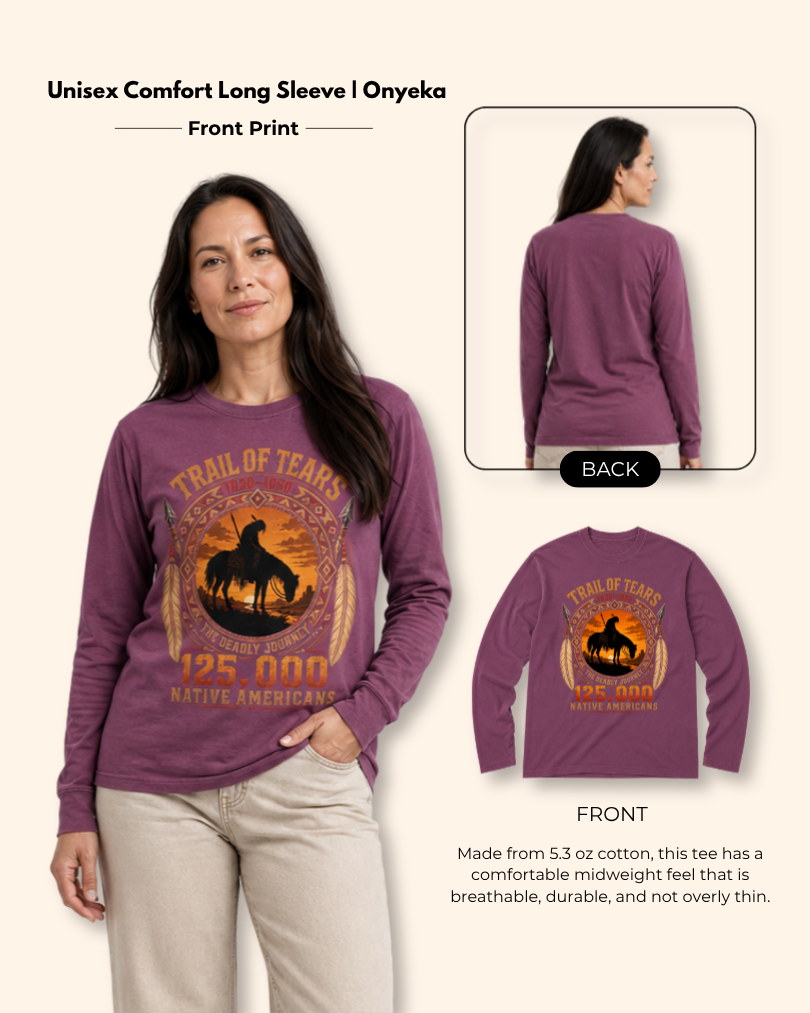
Some carry the road. Some carry the five nations who walked it. Some carry the answer to the question they keep getting asked.
The same argument, worn differently.


Comfort Colors, printed after you order. Made in 1–3 business days, then 4–8 business days in the US. Free shipping over $95.
To wear it on Monday, October 12, order by September 25.
The bottom line
People who had been robbed of everything heard that strangers were starving, and gave.
Ireland built something to remember it by. America built nothing and taught nothing.
And now you know. What happens to that is up to you.
Comfort Colors, printed after you order. Made in 1–3 business days, then 4–8 business days in the US. Free shipping over $95.
To wear it on Monday, October 12, order by September 25.
Americanista is not a Native-owned business, and these are not Indian products under the Indian Arts and Crafts Act of 1990. The design names are ours, not tribal names. We are the people who print the record, not the people it happened to.
We are a small print operation. Not a school, not a tribal government, not a charity. We make no claim that any part of your purchase goes anywhere other than into running this.
Sources: The gift: Choctaw Nation of Oklahoma, “Choctaw and Irish History”; Smithsonian National Museum of the American Indian, “The Choctaw Nation’s Gift to the Irish” (2018). Amount and date: $170 collected March 23, 1847, routed through the Memphis Irish Relief Committee and the General Irish Relief Committee of the City of New York. The memorial: Kindred Spirits by Alex Pentek, Bailick Park, Midleton, County Cork, Ireland. Irish donations to Navajo and Hopi COVID-19 relief in 2020: contemporaneous CNN and NBC News reporting. Choctaw removal began in 1831 under the Indian Removal Act of 1830; a chief on that removal described it to the Arkansas Gazette at Little Rock as “a trail of tears and death.” Shipping and production times from americanista.com/policies/shipping-policy.