The Boarding School Files
The Federal Indian Boarding Schools · 1819–1969
You have seen the photograph.
This is the file.
Between 1819 and 1969, the federal government's boarding-school system reached 417 institutions across 37 states and then-territories — the number the Department of the Interior documented in 2024. Almost everything below was written by the government itself — and every document can be opened and checked at the archive that holds it.
 1819 · the actAn act of Congress
 1884 · the reportsThe school's own record
 1898 · the rulesPrinted by the government
 2024 · the mapEvery site counted
Eighteen archival exhibits below. None of them invented.
A note before you read. This page is about the federal Indian boarding school era (1819–1969) and includes documents that record children's deaths. Read at whatever pace you choose.
If your family is searching for a student's records, start with the Department of the Interior's Federal Indian Boarding School Initiative. For community and support: the National Native American Boarding School Healing Coalition, boardingschoolhealing.org.
It begins with an act of Congress.
On March 3, 1819, Congress passed “An Act making provision for the civilization of the Indian tribes adjoining the frontier settlements.” It appropriated “the annual sum of ten thousand dollars,” and directed the President to employ teachers for Native children.
Its stated purpose, in the law's own words: “introducing among them the habits and arts of civilization.”

Chapter LXXXV of the laws of the Fifteenth Congress, third session — the law that put federal money behind the instruction of Native children.
Read the text
“…for the purpose of providing against the further decline and final extinction of the Indian tribes … and for introducing among them the habits and arts of civilization, the President of the United States shall be … authorized … to employ capable persons of good moral character, to instruct them in the mode of agriculture suited to their situation; and for teaching their children in reading, writing, and arithmetic…”
“Sec. 2. And be it further enacted, That the annual sum of ten thousand dollars be, and the same is hereby appropriated, for the purpose of carrying into effect the provisions of this act…”
The schools wrote everything down.
Carlisle opened in 1879, in Pennsylvania, and became the model. Its own annual reports describe the trades taught, the farm, the students placed out to local families — and the arrivals. In 1884, the report recorded fifty-two Apache youths brought in from the San Carlos Reservation.
By 1898 there were government rules for all of it. Rule 198 covered language: “All instruction shall be in the English language. Pupils shall be required to converse with employees and each other in English.”

The Carlisle section of the Commissioner of Indian Affairs' annual report, ending with an assessment of goods the students had produced.

Outing placements, trades by department, the school farm — and the arrival of fifty-two Apache youths from San Carlos.

The manual the Office of Indian Affairs printed for every school, covering enrollment, discipline, work, clothing, and language.

Rule 198, in full. It is one of 262 rules in the manual.
Read the text
“198. All instruction shall be in the English language. Pupils shall be required to converse with employees and each other in English. All school employees must be able to speak English fluently.”
Thirty years later, the government's own survey.
In 1928, a survey commissioned by the Secretary of the Interior — the Meriam Report — looked at the schools and said it plainly: “the provisions for the care of the Indian children in boarding schools are grossly inadequate.”
The diet was deficient “in quantity, quality, and variety,” based on about eleven cents a day per child. The system ran another forty-one years.

“The Problem of Indian Administration,” submitted to the Secretary of the Interior on February 21, 1928.

The sentence the government's own survey wrote about its own schools.
Read the text
“The survey staff finds itself obliged to say frankly and unequivocally that the provisions for the care of the Indian children in boarding schools are grossly inadequate.”
“The outstanding deficiency is in the diet furnished the Indian children… The diet is deficient in quantity, quality, and variety. The effort has been made to feed the children on a per capita of eleven cents a day, plus what can be produced on the school farm…”
The photographs were made to sell the schools.
The two photographs are the same young man: photographed at Carlisle when he arrived in 1882 — long hair, in his people's clothing — and again a few years later, hair cut, in a school uniform. The school had the pair made and sent them around the country as evidence that it worked.
His name was Tom Torlino, and he was Diné — Navajo. His file survived. It is held with the school's records at the National Archives, and every page of it can be read today. We use his file as the archive holds it, and we speak for no one but ourselves.

The first of the pair: photographed at the school in 1882, in his own clothing.

The second: hair cut, in the school's uniform. It was printed and sent around the country to promote the school.

Navajo. Entered October 21, 1882; discharged August 28, 1886, “by order Dept.” Two outings placed with families in Pennsylvania are recorded on the back.

A form filled in after he was gone. The address on it: Tohatchi, New Mexico.
He went home.
What the government found when it finally counted.
In 2022, the Department of the Interior published the first federal investigation of the schools. It counted 408.
In 2024, after reviewing roughly 103 million pages of government records, it published Volume II: 417 institutions across 37 states or then-territories — and at least 973 American Indian, Alaska Native, and Native Hawaiian children who died while attending them. It also counted at least 74 marked and unmarked burial sites at 65 school sites.
Figures: U.S. Department of the Interior, Federal Indian Boarding School Initiative Investigative Report, Volume II (July 2024).

The Department's first report found 408 federal schools across 37 states or then-territories — 431 sites in all.

The updated list; the confirmed deaths; the burial sites; 103 million pages reviewed.
Read the findings
“Updating the official list of Federal Indian boarding schools to include 417 institutions across 37 states or then-territories;”
“Confirming that at least 973 American Indian, Alaska Native, and Native Hawaiian children died while attending Federal Indian boarding schools;”
“Confirming that there are at least 74 marked and unmarked burial sites at 65 different school sites;”

Appendix D: each dot is a federal boarding school site identified by the investigation, including Alaska and Hawaii — current to January 1, 2024.

The same appendix maps the schools in Alaska and Hawaii — 21 and 7 of them.
The country watched it happen.
In 1902, the New York Tribune gave Carlisle a full illustrated page — photographs of students “making carriages” and “learning to be blacksmiths.”
In 1914, the Ogden Standard reported on sickness and death among children in the government's schools — in the era's own racist language. One headline below carries that language: we show the page as the record, not as our voice. The schools ran for another fifty-five years.

“An attack on the educated Indian, contrasted with figures from the famous Carlisle Indian School” — the school's own showcase, printed for a national audience.

The article reports tuberculosis and deaths among children in the government's schools. Its headline uses the language of its time — shown here as the record, not endorsed.
It is not finished.
The system's last schools closed by 1969. Four off-reservation boarding schools run by the Bureau of Indian Education are still open today.
Behind Carlisle there is a cemetery. One hundred and eighty-six children were buried there before 2017. Since then, the Army has been carrying them home at the request of families and tribes — sixty-five graves opened, fifty-eight children returned, more than a hundred still buried. In April 2024, the Army published a notice naming eleven individuals whose families and tribes had asked for their return.

The Army's notice to disinter eleven individuals, chosen by their families and tribes, at government expense.
Read the text
“…OAC has received written requests for disinterment from the closest living descendent of each of the eleven individuals. OAC will disinter and facilitate the transport and reinterment of the remains to private cemeteries chosen by the families and Tribes at government expense…”
Cemetery figures: U.S. Office of Army Cemeteries program, as reported by Indian Country Today (2026) and The Oklahoman (November 2025). The work continues.
The color comes from one child's story.
September 30 is observed in the United States as the National Day of Remembrance for U.S. Indian Boarding Schools. The orange comes from Phyllis Webstad: in 1973, she was six years old, and her grandmother had bought her a new orange shirt for her first day at a residential school in British Columbia. It was taken from her, and she never wore it again. Years later, telling that story started Orange Shirt Day.
Wear the record into the room.
Not a slogan — a piece of history you can hand to somebody, and answer when they ask.


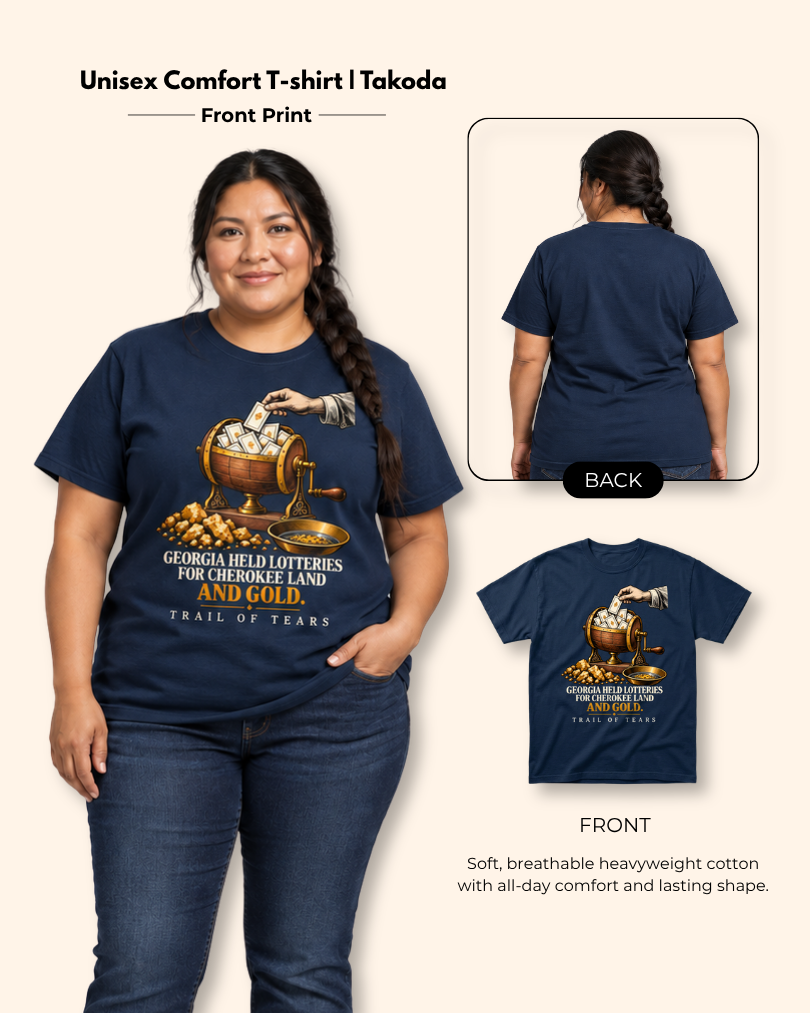
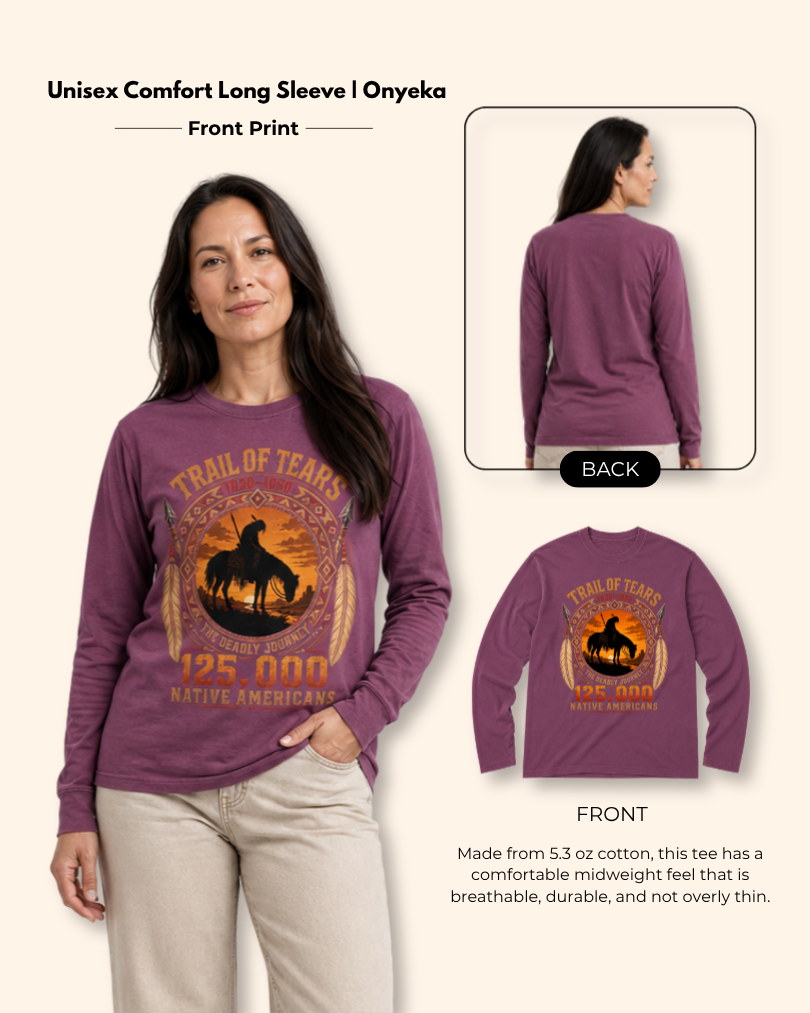
Burnt orange · S–4XL · Every shirt is printed when you order it · Ships from the United States. Independent tribute project — not affiliated with, or endorsed by, NABS, the Orange Shirt Society, any tribe, or any nation.
Check every one.
Nothing on this page is invented. Each document can be opened at the archive that holds it, and every claim in the text traces to a source on this list.
- Civilization Fund Act — 3 Stat. 516U.S. Statutes at Large, Fifteenth Congress · 1819 · GovInfoView at the source ↗
- Commissioner of Indian Affairs, Annual Report — 1881, page 191Internet Archive (Prelinger Library)View at the source ↗
- Commissioner of Indian Affairs, Annual Report — 1884, page 188Internet Archive (Prelinger Library)View at the source ↗
- Rules for the Indian School Service — 1898Office of Indian Affairs · Government Printing Office · Internet Archive / Newberry LibraryView at the source ↗
- The Problem of Indian Administration (“Meriam Report”) — 1928Institute for Government Research · Internet ArchiveView at the source ↗
- Tom Torlino student fileNational Archives and Records Administration, RG 75, Series 1327, box 18, folder 872 · via the Carlisle Indian School Digital Resource CenterView at the source ↗
- Federal Indian Boarding School Initiative Investigative Report, Volume I — 2022U.S. Department of the Interior / Bureau of Indian AffairsView the report ↗
- …Volume II — 2024U.S. Department of the Interior / Bureau of Indian Affairs · includes Appendix D: maps of school sitesView the report ↗
- Off-Reservation Residential Schools — still operatingBureau of Indian Education: Chemawa, Flandreau, Riverside and Sherman Indian · bie.eduVisit ↗
- New-York Tribune — December 7, 1902Library of Congress, Chronicling AmericaView at the source ↗
- The Ogden Standard — June 27, 1914, page 16Library of Congress, Chronicling AmericaView at the source ↗
- Notice of Intended Disinterment — Federal Register, April 9, 202489 FR 24805–24806 · Department of the Army, Office of Army Cemeteries · GovInfoView at the source ↗
- National Native American Boarding School Healing CoalitionThe National Day of Remembrance (September 30) and family resources · boardingschoolhealing.orgVisit ↗
- Orange Shirt SocietyPhyllis Webstad's story and Orange Shirt Day · orangeshirtday.orgVisit ↗
- Before-and-after portraiture at CarlisleMaría Beatriz H. Carrión, Rutgers Art Review — the promotional purpose of the pair · rar.rutgers.eduRead ↗
- Carlisle Barracks Post Cemetery — repatriation programU.S. Office of Army Cemeteries; figures as reported by Indian Country Today (2026) and The Oklahoman (November 2025)Visit ↗
Americanista is not affiliated with any nation, tribe, or organization, and no purchase funds any program. This is a tribute project: we research, we cite, and we print.