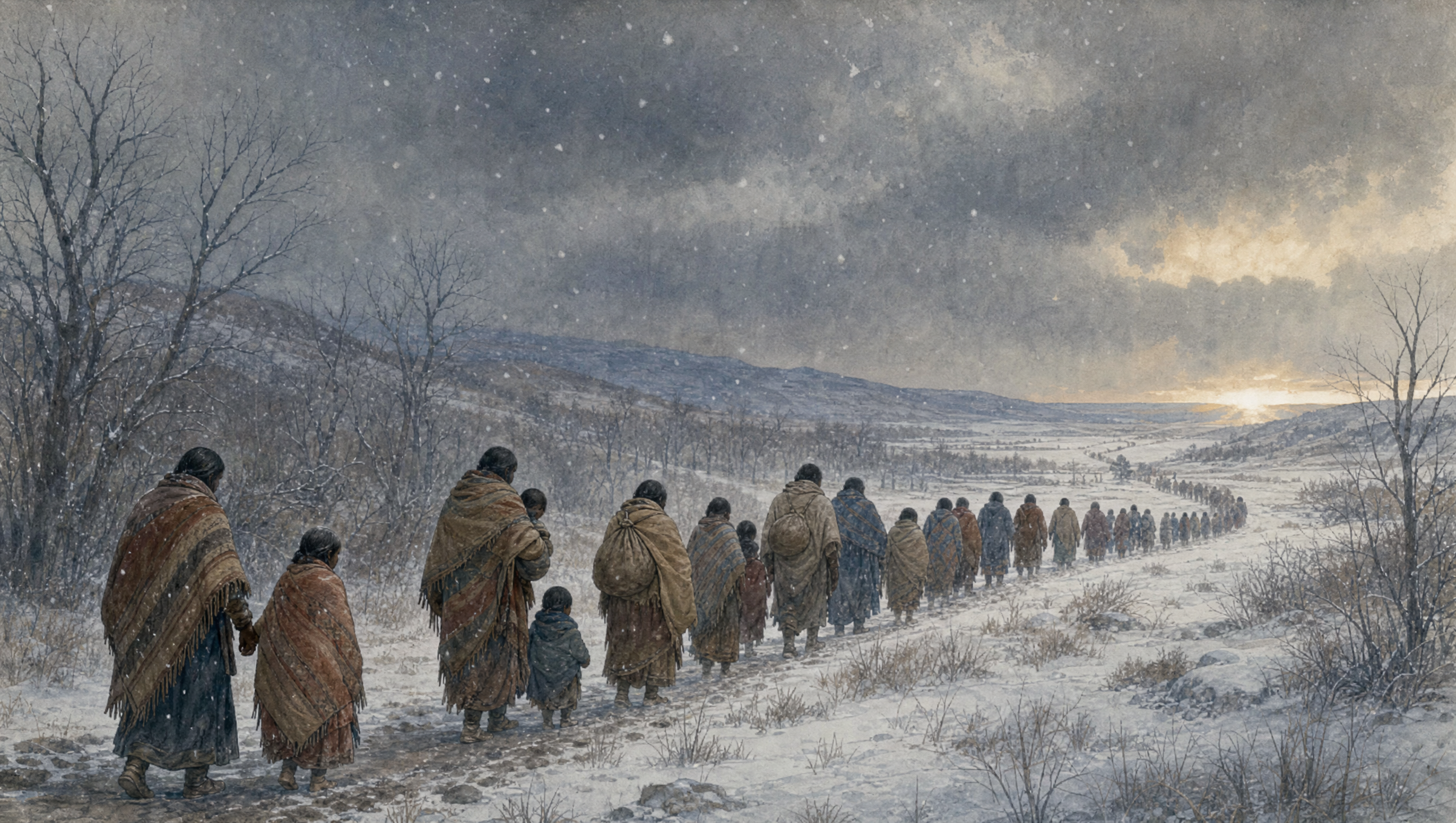

Most Americans first hear the words Trail of Tears in a single paragraph of a history class. A forced march. A long time ago. Then the page turns. What that paragraph leaves out is almost everything that matters. The law that ordered it. The nations it emptied. The thousands who never arrived. Here is the fuller story, told plainly and with respect.
It Began With a Law
On May 28, 1830, President Andrew Jackson signed the Indian Removal Act. The law gave the federal government power to push the nations of the southeast off their homelands and onto territory west of the Mississippi River, in what is now Oklahoma. It was framed as a fair exchange. It was not. Communities that had farmed, governed, and buried their dead on that land for generations were told to leave it behind.
Five Nations, One Forced March
The removal fell hardest on five nations. The Choctaw, the Muscogee (Creek), the Chickasaw, the Seminole, and the Cherokee. The Choctaw were forced out first, beginning in the winter of 1831, without enough food, blankets, or shelter for the cold. A Choctaw leader described that journey as a trail of tears and death. The name carried.
The Cherokee removal came later and is the one most people picture. After a treaty signed by only a small faction, the United States gave the Cherokee Nation two years to leave. When most refused, soldiers arrived in 1838. Families were taken from their homes at gunpoint, held in stockades, then marched roughly a thousand miles west.
The Cherokee called it Nunna daul Tsuny. The trail where they cried.
The Numbers History Class Skipped
The scale is hard to hold in the mind. These figures come from the historical record, and even the careful estimates are staggering.
They died of exposure, of hunger, of disease that spread through crowded camps, and of grief. The dead were often buried where they fell, with no marker and no time to mourn. Whole family lines ended on the road.
The Names Behind the Numbers
A number is easy to forget. A person is not. Among those who walked were elders who could no longer farm but still carried the old stories. Mothers who gave birth on the trail and kept walking. Children who arrived in a strange land with no one left to raise them. The point of remembering is not to drown in the figures. It is to keep the people inside them from disappearing a second time.
Why You Were Never Taught This
This history is not hidden because it is unknown. It is hidden because it is uncomfortable. Studies of state curricula have found that the large majority stop teaching Native history around 1900, and many never require it at all. A story with its hardest chapters removed is easier to tell. It is also a lie of omission. Remembering the Trail of Tears is not about guilt. It is about respect, and about telling the truth in full.
We choose to remember out loud.
Our Trail of Tears collection was made to carry this history into daily life. Each design is drawn with reverence, in partnership with Native artists. Not a slogan. A tribute you can wear.
Explore the Trail of Tears CollectionIf you want to start with the design that began it all, many people choose the Kiona Trail of Tears tee. You can also browse the pieces people carry most.
Sources and further reading: the National Park Service Trail of Tears National Historic Trail, the Cherokee Nation, and the National Museum of the American Indian. Estimates of those removed and those lost vary across sources. We use the widely cited ranges and welcome correction from descendant communities.