If you were ever taught anything about the Trail of Tears beyond a date, there is a good chance it came from one letter. A soldier named John G. Burnett, writing in 1890 on his eightieth birthday, describing what he said he saw. It is quoted in books. It is on history sites. It is handed out on school worksheets right now.
It is a forgery.
The researcher Larry A. Vogt worked out something nobody had checked: Burnett's company was disbanded in April 1837 — a year before the removal his letter describes. It appears to have been written by his grandson. Historians accepted it for decades; John Ehle cited it as a primary source in his history of the Cherokee Nation.
So the most-repeated voice from the Trail of Tears belongs to a man who was not on it. And the sixteen thousand people who were left almost nothing anybody bothered to keep.
TO BE PERFECTLY CLEAR ABOUT WHAT IS AND IS NOT IN DOUBT
One letter is fake. The removal is not. It is one of the most heavily documented things the United States government has ever done to anyone, because the government did the documenting itself:
An act of Congress — the Indian Removal Act, signed 28 May 1830. A treaty the Cherokee National Council never ratified — New Echota, 1835. Army orders under General Winfield Scott, May 1838. Muster rolls. Appropriations. Contracts for rations and wagons. A Supreme Court ruling the state of Georgia simply ignored.
Nothing here rests on that letter. Everything below names the record it comes from, and you can go and read it. That is the difference this page is about.
What people carry it on instead


Vendor: Americanista
Kaira — Trail of Tears — Heritage Tee


Vendor: Americanista
Imala — Trail of Honor — Heritage Tee


Vendor: Americanista
Kiona — Trail of Tears — Heritage Tee


Vendor: Americanista
Talona — Stolen Native Children — Heritage Tee

HOW A FORGERY BECOMES THE SOURCE
It did not survive a century because people were stupid. It survived because it was the only thing on the shelf. There was a hole where the testimony should have been, and something moved into it.
That is what an absent record does. It does not stay empty and politely wait. It gets filled — by the wrong document, by a half-memory, by whoever is talking loudest.
A correction always travels slower than the thing it corrects. The letter had a hundred and thirty years' head start, and it is still winning.

IT IS STILL BEING HANDED OUT
The letter is not sitting in an archive where only specialists meet it. It is a teaching resource. It is short, it is vivid, it is free, and it fits on one photocopied side of A4 — which is most of what decides whether a document gets taught.
Meanwhile the actual record — muster rolls, contracts, army correspondence — is long, dull, and written by people with a reason to be tidy. Nobody photocopies a ration contract for a Tuesday lesson.
So a generation of children learn the removal through a document written by somebody who was not there, and learn nothing about the fact that nobody counted the dead.
WHAT THE REAL PAPERWORK SAYS, IN SIX LINES
28 May 1830 — the Indian Removal Act passes the House by five votes.
1831 — the Choctaw go first, through the worst winter in memory. A Choctaw leader, quoted in an Arkansas newspaper as the removal passes, calls it “a trail of tears and death”. That is where the name comes from — said at the time, by somebody walking it.
1832 — the Cherokee Nation takes Georgia to the Supreme Court and wins. Georgia carries on regardless.
May 1838 — troops drive Cherokee families into holding stockades. 16,000 removed.
Winter 1838-39 — about 4,000 never finish the walk. National Park Service.
1831-1838 — roughly 100,000 people removed across five nations. The rolls that would say how many arrived were never reconciled. There is still no agreed death toll.

YOUR GRANDCHILDREN WILL LEARN HIS NAME, NOT THEIRS
Ask anyone who signed the Indian Removal Act and a good number can tell you. Andrew Jackson. Seventh President. He is in your wallet — the twenty.
Now ask for the name of one person who walked. Not a chief, not a treaty signatory — one of the sixteen thousand. Almost nobody can. Not because the names never existed, but because nobody was made to write them down, and nobody has been made to since.
That asymmetry is not an accident of time. It is the arrangement working exactly as designed. The man who ordered it is on the currency; the people it was done to do not have a number, let alone names.
And it holds by default. Nobody has to do anything to keep it that way — that is the whole trick of it. It only changes if somebody makes it inconvenient to ignore.

IT TOOK A HUNDRED YEARS BEFORE ANYONE WENT AND ASKED
In 1936 the Oklahoma Historical Society and the University of Oklahoma got a grant from the Works Progress Administration and sent interviewers out across the state to write down what people remembered. The result is the Indian-Pioneer Papers: more than 11,000 interviews, typed up and bound into 112 volumes. You can search it online today.
Read that date again. 1936. Nearly a century after the removal. By the time anybody thought to go and ask, everyone who had walked it was long dead. What survives is the generation after, repeating what they had been told.
The forged letter was written in 1890. The real interviews started in 1936. The fake had a forty-six year head start, and it is the one that got famous.
Trail of Tears Commemorative Collection
A post is read by people who already agree with you, and it is gone by tomorrow. A comment is read by nobody. Neither of them ever reaches the person who has simply never heard any of this — which is most people.
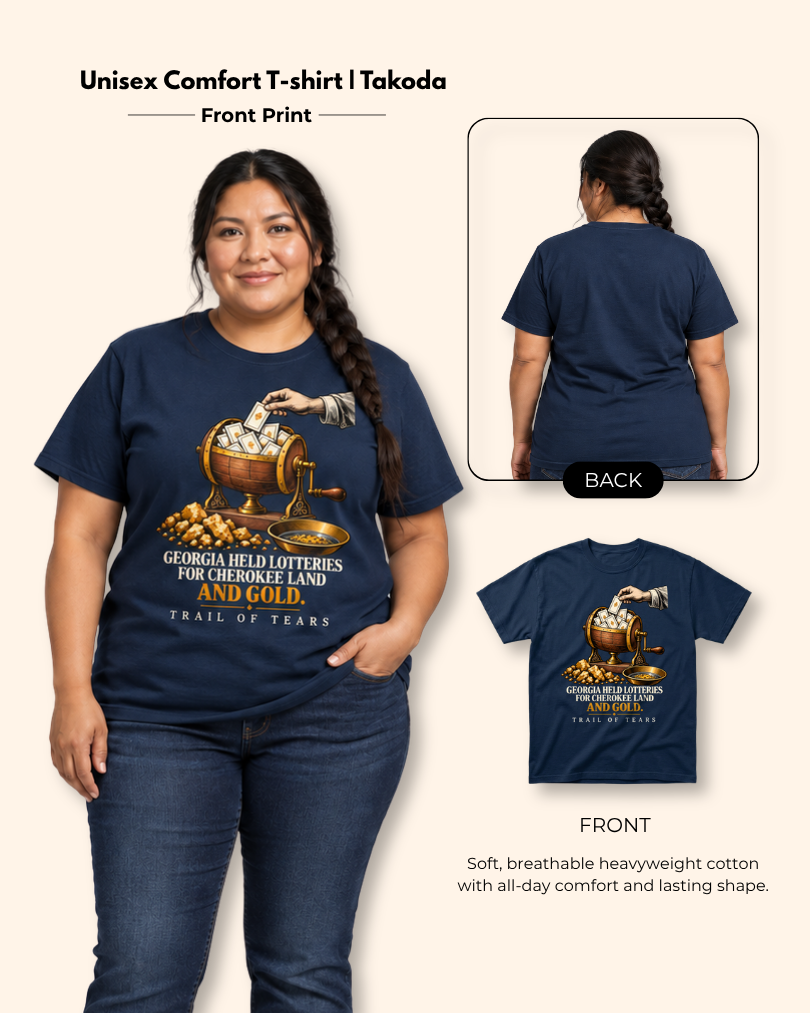
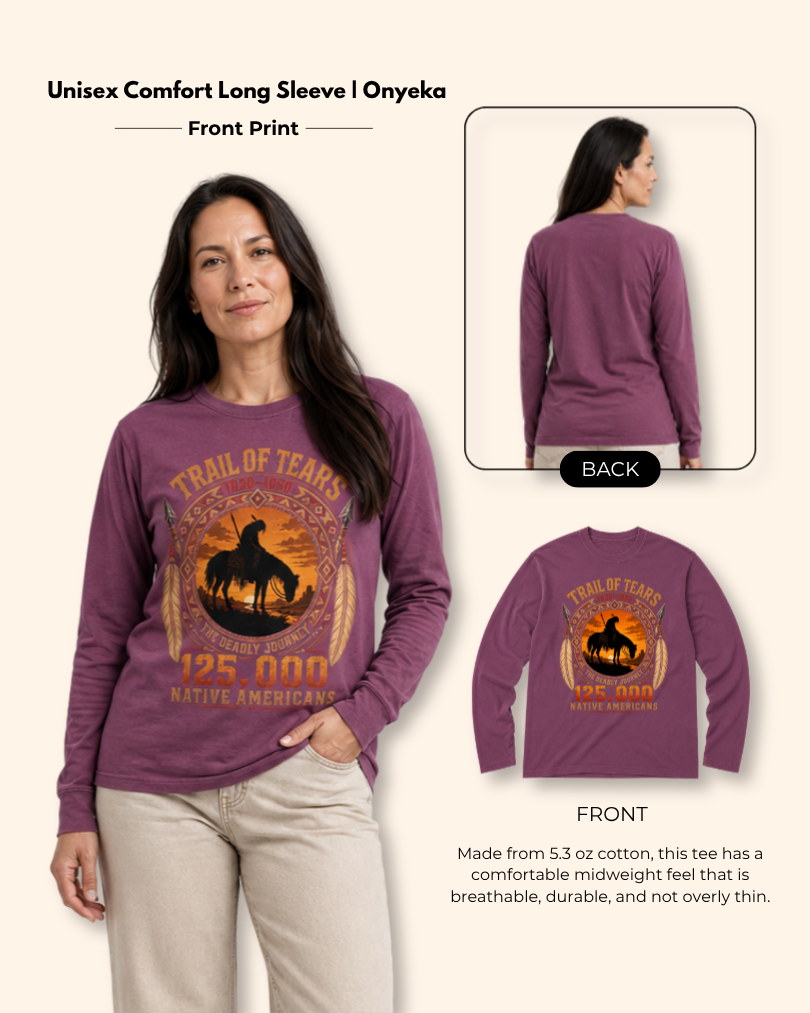
Every design here prints something specific and checkable — a date, a route, a nation, a count — big enough that a stranger reads it across a room without choosing to. In a queue. In a waiting room. On an ordinary Tuesday.
Then they ask what it means, and you get to answer. That is the entire mechanism, and there is no substitute for it.

Customers, at home, on an ordinary day
THE RIPPLE EFFECT OF TRUTH
A shirt is not a monument. It is smaller, and it moves — to the grocery store, the waiting room, the school pickup line, where a monument is never going to reach. Somebody reads it over your shoulder and asks what it means. That question is the whole mechanism.
Tap a clip for sound. Tap the name to see that design.
WHAT PEOPLE WHO ACTUALLY WEAR THESE SAY
Copied word for word out of the store’s review app — names, products and all. Including the one about the sizing.
IRENE L R.
I LOVE the color!! The shirts get people's attention...good conversation starters. I can tell as we talk, looking back at what was done, it is NOT a proud time for Americans. But "sorry" just doesn't fix anything.

Rudolph A D.
I'm very much into the True Original keepers of this land. I support all that they do to educate the country as to their Rich and Valuable History to their Home. I wear the Tee with pride!

Linda K.
The shirt I ordered came on time in a soft pack. I took the advice provided and got a size larger. It fits perfect. I wear it to remind others of what was done to a whole nation of people just because we wanted what they had-land. Land they didn't claim as theirs but cared for for the great creator God. Thank you!

Joyce S.
I love both t-shirts. They fit comfortably and wear well and express how I feel.

Micheal E.
I received my shirt as promised. Unfortunately, I have not gotten to wear it. My wife took it from me and wore it to her school. She says she got numerous compliments on it. I guess I'm going to have to order another one if I am going to get to wear it!

Denver S.
You need to make options of putting messages on the front and back of your shirts. Give people the option of choosing the messages to put on front and back. I believe you will sell many more.
WHEN SOMEBODY ASKS, HERE IS THE LINE
You will not have to make a speech. You will get one question, usually a polite one, usually from someone who is not looking for an argument. Here is the whole answer:
“The most famous eyewitness account of this turned out to be a fake. Nobody ever agreed how many people died. That is why I'm wearing it.”
Two sentences. Both checkable in thirty seconds on the phone in their hand. That is one more person than yesterday who knows, and it happened because something was readable across a room.
No countdown on this page, and no discount clock. The urgency is not ours to manufacture — the forged version has had a hundred and thirty years of head start, and it gains another day every day nobody says otherwise.
IF IT ISN'T RIGHT, YOU ARE NOT STUCK WITH IT
Buying a shirt online from a shop you have not bought from before is a small act of trust. Here is exactly what happens if it goes wrong — no countdown, no invented statistics, nothing we cannot stand behind.